
This Is What a Rug Pull Looks Like Before It Happens

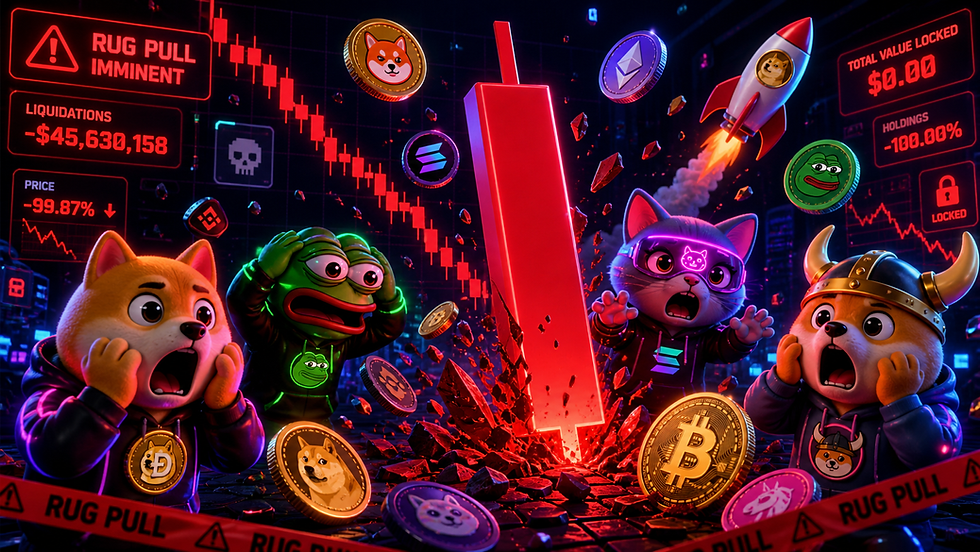
Nobody gets rugged thinking they are about to get rugged.
That is the part people miss when they read post-mortems. They read the story after the collapse and assume they would have seen it coming. The anonymous founders. The unlocked liquidity. The whitepaper that was mostly formatting. They read these details in retrospect and think: that was obvious.
It was not obvious. Not at the time. Not to people who were intelligent, experienced, and paying attention.
Because rug pulls are not primarily a technical failure. They are a social engineering operation. And social engineering works by exploiting the same instincts that make people good at other things: trust, pattern recognition, enthusiasm, and the very human desire to have found something real before everyone else did.
This article is not a list of red flags to memorize. Red flag lists get outdated. The people running these operations read the same lists and adjust accordingly.
What this article is about is the structure underneath. The mechanics that make rug pulls possible, the psychological conditions that make them effective, and the framework questions that change what you see before the collapse rather than after.
What a Rug Pull Actually Is
A rug pull is an exit scam. The team behind a project raises capital, whether through a token sale, liquidity provision, NFT mint, or investment round, and then removes that capital. Sometimes quickly. Sometimes gradually. Sometimes after months of building apparent legitimacy.
The name comes from the image of pulling a rug out from under someone. One moment you are standing on something solid. The next moment there is nothing underneath you and you are already falling.
There are three broad categories:
Hard pulls are the dramatic ones. Liquidity drained overnight. Social media accounts deleted. Website gone. These are the ones that make news and generate the screenshots that circulate for weeks afterward. They are also, in a way, the most honest version of the scam. They do not pretend to be anything other than what they are.
Soft pulls are slower and more sophisticated. The team does not disappear. They simply stop. Development slows, then halts. Roadmap items get quietly removed or pushed back indefinitely. The founders become harder to reach. The community moderators start deleting critical questions instead of answering them. Nothing dramatic happens. The project simply becomes worth nothing over a period of months, and by the time that is undeniable the founders have already sold their allocations.
Migration scams are the most technically elaborate. A project announces it is migrating to a new contract, a new chain, or a new version of its token. Holders are asked to swap their existing tokens for the new ones. The new contract is the exit. The old tokens are honored just long enough to create confidence. Then they are not.
Each of these operates differently at the technical level. They operate identically at the psychological level.
The Architecture of Manufactured Legitimacy
Before a rug pull works financially, it has to work socially. A project has to become believable. That believability is constructed deliberately, and understanding how it is constructed is the first step toward seeing through it.
The founding story.
Every successful rug pull has a compelling origin narrative. A problem the founders experienced personally. A gap in the market they identified through their professional background. A mission that sounds larger than profit. The story does not have to be verifiable. It has to be emotionally coherent.
Humans are story-processing animals. We evaluate credibility through narrative consistency, not documentation. A well-told founding story creates a sense of knowing the people involved, even when you know nothing verifiable about them at all.
The community architecture.
Rug pulls do not sell tokens. They sell belonging. The Discord server is designed to feel like an inner circle. The Telegram group rewards early members with roles and status. The founders engage directly with community questions in the early stages, creating the impression of accessibility and transparency.
This is deliberate. A person who feels like a valued community member is not evaluating the project the same way an outside investor would. They have social stakes in the outcome. Raising questions feels like a betrayal of the group rather than due diligence.
The credibility stack.
Audits. Partnerships. Media coverage. KOL endorsements. Each of these can be fabricated, purchased, or misrepresented at a cost that is trivial relative to the capital being raised.
Audit firms that charge $500 for a report exist. Partnerships with legitimate-sounding organizations can be announced unilaterally and never verified. Media coverage in crypto publications operates on a pay-to-play model that is poorly understood outside the industry. Influencers with large followings accept payment for promotion without disclosing it consistently.
None of these signals mean what people assume they mean. But they stack. And a stack of individually weak signals creates a composite impression of legitimacy that is surprisingly durable.
The urgency architecture.
Limited supply. Whitelist spots closing. Early investor rounds at preferential prices. Launch dates that create countdown pressure. These mechanisms exist in legitimate projects too, which is precisely why they work in illegitimate ones.
Urgency compresses the time available for evaluation. A person making a decision under time pressure uses fewer data points, weighs social proof more heavily, and is more susceptible to the credibility stack described above. The urgency is not incidental to the scam. It is load-bearing.
What People Are Actually Evaluating
When someone assesses a project before investing, they think they are evaluating the fundamentals. Tokenomics. Use case. Team background. Market opportunity.
What they are actually evaluating, in most cases, is their emotional response to the project's social presentation.
This is not a criticism. It is how human cognition works under conditions of uncertainty. When the underlying reality is opaque, which it almost always is in early-stage crypto, the brain fills the gap with social and narrative cues. How does the team communicate? How do other community members seem to feel? Does this remind me of something that worked before?
Rug pull architects understand this better than most investors do. They are not building projects. They are building emotional environments that produce a specific cognitive state in their target audience: the state of wanting to believe.
When you want to believe something, the threshold for accepting evidence that confirms it drops dramatically. The whitepaper that is mostly marketing copy gets read as vision. The anonymous founder gets reframed as privacy-conscious rather than unaccountable. The audit from an unknown firm gets treated as equivalent to one from a reputable one.
This is not stupidity. It has happened to sophisticated people across every category of financial fraud in history. The mechanism is human. The exploitation of it is deliberate.
The Questions That Change What You See
Red flag lists are backward-looking. They describe what the last generation of rug pulls looked like. The next generation will look different enough to make most of those lists feel irrelevant.
What does not change is the underlying structure. And there is a set of questions that probe that structure directly, regardless of how the surface presentation has evolved.
Who bears the cost if this fails?
Map where the capital goes and when. What percentage of raised funds can the team access immediately? What vesting schedules exist, and are they enforced by code or by promise? If the project fails tomorrow, what does the team lose personally?
In legitimate projects, founders carry real downside. They have equity that is worth nothing if the project fails, reputations that are tied to the outcome, and capital that is locked on terms comparable to investors. When those conditions are absent, the incentive structure is telling you something.
What happens when someone asks a hard question?
Test the community before you test the project. Ask something specific and uncomfortable. Ask about the unlock schedule for team tokens. Ask what happens to raised funds if the roadmap is not executed. Ask for the audit firm's track record on other projects.
Watch what happens. Legitimate projects with confident teams answer hard questions directly, even if the answer is imperfect. Projects built on manufactured legitimacy moderate, deflect, or attack. The community response to skepticism is often more informative than the whitepaper.
Can I verify the team's prior claims independently?
Not through the project's own materials. Through independent sources that have no relationship to the project. LinkedIn profiles that predate the project. Academic credentials that can be cross-referenced. Previous companies that have verifiable histories.
Anonymous teams are not automatically fraudulent. Pseudonymity has a legitimate history in crypto. But when a team makes specific claims about their background and experience, those claims should be verifiable. When they are not, that gap is information.
What does the liquidity structure actually look like?
This is technical, but the core question is simple: can the team remove the liquidity unilaterally, and if so, what prevents them from doing so?
Locked liquidity, enforced by code with a verifiable timelock, is different from promised liquidity. Smart contract audits that specifically address exit vectors are different from general security audits. If you cannot answer this question from publicly verifiable on-chain data, you are trusting a promise. Understand that you are trusting a promise.
The Honest Summary
There is no checklist that makes rug pulls impossible to miss. The people running them are adaptive and intelligent, and they update their methods faster than public awareness updates its defenses.
What changes the outcome is not a better list. It is a different orientation toward uncertainty.
Most retail investors approach a new project looking for reasons to believe. The research process becomes confirmation-seeking dressed up as due diligence. The questions asked are the ones likely to produce reassuring answers. The red flags that surface get rationalized because the emotional commitment to the project precedes the evaluation of it.
The orientation that actually protects you is structurally different. It starts from the assumption that you cannot verify most of what you are being told, and it asks what the evidence looks like if the project is not what it claims to be. It runs the thesis in reverse. It is less interested in what the team says and more interested in what the incentive structure implies.
This is harder than it sounds. It requires holding your enthusiasm at a distance while you examine something you want to be real. It requires being willing to walk away from something that felt promising.
It also requires practice. The framework does not arrive fully formed. It gets built through deliberate exposure to how these things fail, through studying the post-mortems not for the red flags but for the moments where the outcome was still preventable.
That is the work. And it is worth doing before the chart, not after.
DEXENTRAL publishes weekly on risk frameworks, digital asset structure, and the parts of crypto investing that most sources skip. If this resonated, share it with someone who needs to read it.


Comments