
WEF 2026 Crypto Roundup
Jan 25, 2026 | 04:00 UTC
— Key Insights from Davos: Tokenization, Regulations, and Crypto's Global Integration
Crypto Takes Center Stage at Davos
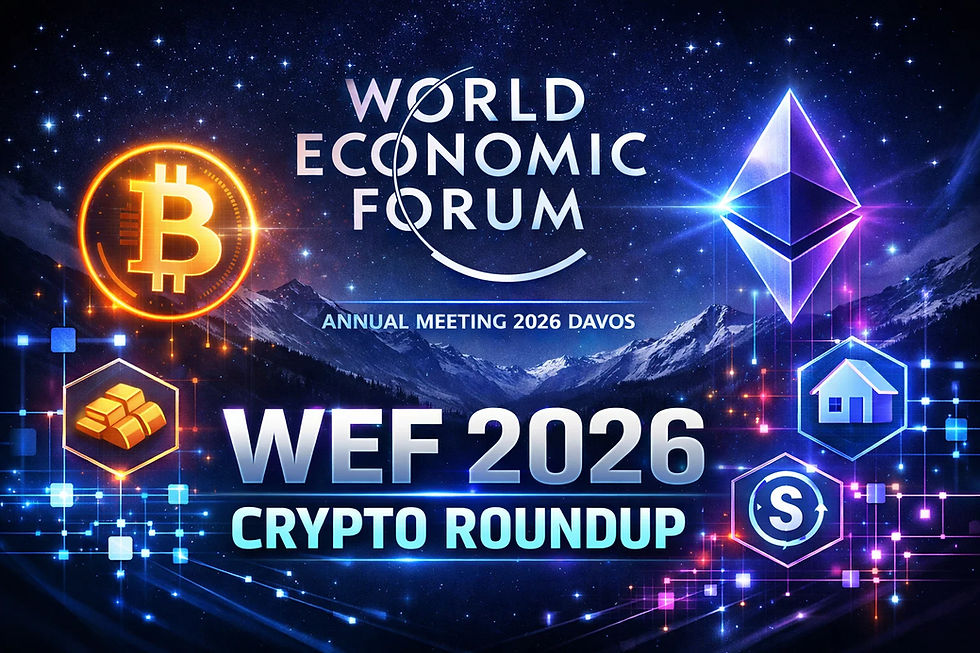
The World Economic Forum (WEF) Annual Meeting 2026, held from January 18-22 in Davos, Switzerland, marked a pivotal shift for cryptocurrency and digital assets. Under the theme "A Spirit of Dialogue," crypto discussions evolved from speculative debates to practical strategies for global finance integration. With participation from heads of state, CEOs, and policymakers, the forum highlighted tokenization, stablecoins, regulatory advancements, and AI's role in crypto. This newsletter extracts key highlights from major speeches, panels, and discussions, including insights from influential figures driving these topics forward.
Tokenization: Unlocking Assets for the Masses
Tokenization emerged as one of the hottest topics, with panels like "Is Tokenization the Future?" emphasizing its potential to democratize access to real-world assets (RWAs) such as securities, real estate, and funds. Speakers argued that blockchain enables fractional ownership, boosts liquidity, and reduces intermediaries, potentially expanding investable markets beyond traditional stocks and bonds.
Larry Fink (CEO, BlackRock): "The future of assets is tokenised. More and more financial assets will be tokenised into digital wallets on a single blockchain. There are too many middlemen. Tokenisation is necessary to reduce corruption. Gold and Bitcoin are assets of fear." Fink, whose firm manages over $10 trillion in assets, has been a vocal proponent of tokenization, piloting projects like tokenized funds to streamline global finance.
Brian Armstrong (CEO, Coinbase): "Tokenization is democratizing access to capital markets for 4 billion adults. This creates entirely new market structures." Armstrong, leading one of the largest U.S. crypto exchanges, highlighted how tokenization opens assets previously reserved for institutions, responding to critics by noting, "That argument [Bitcoin is worthless] has already been settled by reality."
Brad Garlinghouse (CEO, Ripple): "Tokenization opens assets that were previously reserved for institutions." Garlinghouse, whose company focuses on cross-border payments via XRP, predicted crypto markets reaching all-time highs in 2026 due to regulatory progress and institutional interest.
CZ (Founder, Binance): Discussed tokenizing state assets with about 10 governments, noting, "The logic is simple: start with financial upside, then build markets, infrastructure, and industries." CZ, the influential founder of the world's largest crypto exchange, emphasized tokenization as a growth pillar alongside payments and AI.
Institutions like BlackRock, BNY Mellon, and Euroclear are actively deploying tokenization at scale, signaling a convergence of TradFi and blockchain.
Stablecoins: The Plumbing of Global Finance
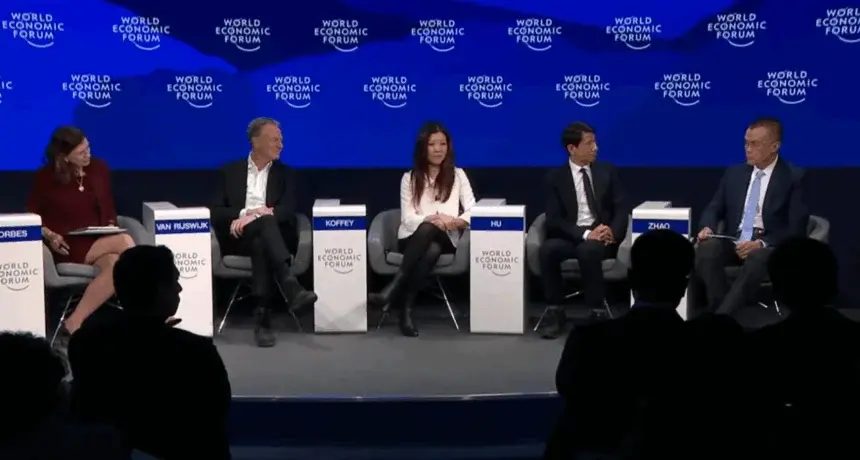
The panel "Where Are We on Stablecoins?" focused on their role in efficient cross-border payments and institutional adoption, surpassing legacy systems in speed and cost. Discussions tied stablecoins to inflation protection and financial inclusion in emerging markets.
Jeremy Allaire (CEO, Circle): "Stablecoins are becoming the global plumbing of finance. This isn’t theory anymore. It’s production." Allaire, behind USDC (one of the leading stablecoins), stressed their scalability for real-world use cases.
Vera Songwe (Senior Fellow, Brookings Institution): Highlighted how stablecoins can shield against inflation in Africa. Songwe, an economist focused on African development, advocated for digital assets in volatile economies.
Yat Siu (Co-Founder, Animoca Brands): "Small earnings in digital assets can become real savings, boosting financial inclusion and financial literacy in places like the Philippines and Indonesia." Siu, a leader in Web3 gaming and investments, connected stablecoins to everyday savings in Asia.
Regulatory clarity, such as the U.S. GENIUS Act, was credited with accelerating stablecoin growth.

Regulatory Progress and U.S. Leadership
U.S. policy took the spotlight, with talks on becoming the "crypto capital of the world" amid bills like the GENIUS Act for market structure.
Donald Trump (U.S. President): "The US will be the world capital of AI and crypto. I’m working to ensure America remains the crypto capital of the world. Congress is working very hard on crypto market structure legislation, which I hope to sign very soon." Trump's administration pushed for pro-crypto policies to maintain global dominance.
David Sacks (White House AI and Crypto Czar): "After market structure legislation passes, banks will fully enter crypto. There will be one digital assets industry. Banks like paying yield. They will be in the stablecoin business." Sacks, overseeing U.S. crypto and AI policy, forecasted hybrid finance post-regulation.
Nilmini Rubin (Head of Global Policy, Hedera): "The US needs regulatory clarity…fast..or it risks losing leadership." Rubin, from the enterprise blockchain network Hedera, warned of competitive risks.

President Donald Trump delivers a special address in Davos, Switzerland, Jan. 21, 2026.
AI and Crypto: A Symbiotic Future
Integration of AI with crypto was a forward-looking theme, positioning blockchain as the infrastructure for AI agents.
CZ (Founder, Binance): "Crypto is the native currency for AI agents. AI won’t pay with bank cards; blockchains are the natural interface." CZ envisioned machine-to-machine transactions scaling adoption.
Dominic Williams (Founder, DFINITY/ICP): "AI and blockchain will merge into sovereign, on-chain systems. The internet itself is becoming programmable." Williams, behind the Internet Computer Protocol, discussed programmable AI on-chain.
Michael Miebach (CEO, Mastercard): Predicted "stablecoins and digital assets, agentic AI commerce, and the need to secure the digital economy" as 2026 trends. Miebach leads Mastercard's push into crypto payments.
Payments and Infrastructure: From Backend to Mainstream
Panels stressed blockchain's role in efficient payments and hybrid systems.
Gordon Liao (Chief Economist, Circle): "Blockchain infrastructure enables global payments at scale. The inefficiencies of current payment rails make this inevitable." Liao analyzed economic impacts of on-chain payments.
Sergio Ermotti (CEO, UBS): "Blockchain is the future for traditional banking." Ermotti, managing $6.9 trillion at UBS, sees blockchain transforming legacy finance.
Richard Teng (Co-CEO, Binance): "Tokenization and blockchain adoption will define the next market cycle. 2026 could be a new all-time high year." Teng, steering Binance's institutional focus, highlighted momentum in on-chain assets

Sergio Ermotti in Davos, on Jan. 21.Photographer: Krisztian Bocsi/Bloomberg
Conclusion: A Multi-Decade Opportunity
WEF 2026 signaled crypto's maturation, with discussions shifting from "if" to "how." As Brad Garlinghouse noted, "This is a multi-decade growth opportunity, not a short-term trade." For DEXENTRAL readers, this underscores the importance of staying ahead in DeFi, RWAs, and AI integrations. Watch for U.S. legislation and global pilots – the rails are being built.
This article is part of DEXENTRAL’s weekly newsletter.


Comments